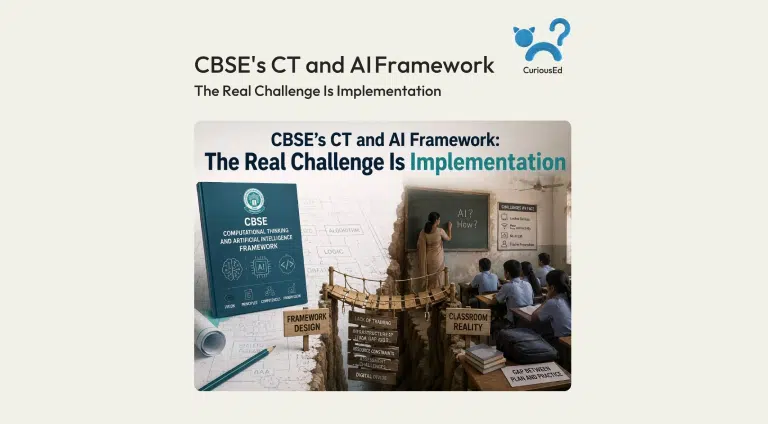
CBSE’s new Computational Thinking and AI framework marks a meaningful shift in school computing education. CT is now expected to move across Mathematics, Science, Language, and Social Science, instead of being a standalone subject.
This signals a significant and educationally sound move. But for school leaders, the harder question is: how will this meaningfully work in classrooms?
Four implementation challenges worth naming:
As CT is distributed across subjects, ownership becomes unclear.
- Who ensures progression?
- Who tracks learners’ growth across grades?
- Without a clear answer, integration becomes diffusion of responsibility.
Exposure also isn’t the same as development. A student may encounter logic in Mathematics and data in Science — but CT requires algorithmic thinking, debugging, and structured problem-solving built systematically over time. Left to individual teacher comfort, progression will be uneven.
Flexibility without structure compounds this. By Grades 7 and 8, learners are expected to move from awareness into application and creation. This requires structured pathways, not occasional computational activities. Therefore, flexibility without a sequenced implementation can result in fragmented progression among learners.
And AI readiness — not just awareness — demands data literacy and computational logic developed over years, not introduced in isolation. If the strong foundations of these competencies are not systematically developed, AI education risks becoming superficial.
The operational reality
With roughly 100 hours a year for Classes 6–8, schools face a concrete choice: treat CT as loose integration or build a structured pathway with measurable learning outcomes. The decision about how CT needs to be taught, assessed, and reinforced matters because computational depth rarely emerges from sporadic exposure alone.
How CuriousEd approached this
We treated the CBSE framework not only as a syllabus update but also as the beginning of an institutional transition — and asked a different question: not what should learners’ study, but how can schools implement this vision consistently and sustainably?
This approach led to a framework built on five strands:
- Algorithms and Programming
- AI
- Data Handling
- Digital Systems
- Digital Citizenship
Each strand progresses in complexity across Grades 6 to 8. A Grade 6 learner works with block-based logic; by Grade 8, the same learner is writing structured Python, interpreting datasets, and reasoning through AI ethics. This shows that progression is visible; outcomes are observable.
However, this doesn’t abandon interdisciplinary integration. Science lessons use simulations and data tools. Maths includes logical modelling. Social Science explores digital citizenship. Language classrooms use sequencing and digital storytelling. The specialist-supported computational strand ensures continuity; subject integration ensures relevance.
Structure creates depth. Integration creates relevance. Schools need both.
While CBSE’s framework for Grades 9 and 10 is yet to be formally released, the trajectory already points toward deeper computational application and AI integration in higher grades. Therefore, schools need to think not only about immediate implementation, but also long-term continuity.
The schools that navigate this transition won’t simply be the first to adopt the framework — they’ll be the ones that build the structures to sustain it.
By Rutwija Sawant, CuriousEd
Rutwija is the Subject Lead for Computer Science at CuriousEd, where she leads the Computer Science team and spearheads the development of academic content and learning resources. With nearly 16 years of experience in CBSE and Cambridge education, she brings deep expertise in curriculum design, pedagogy, and subject-matter mastery to support high-quality learning outcomes.